#include <rlsocket.h>
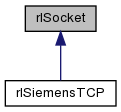
Public Types | |
| enum | SocketEnum { SOCKET_ERR = -1, SETSOCKOPT_ERR = -2, LISTEN_ERR = -3, ACCEPT_ERR = -4, INET_ADDR_ERR = -5, CONNECT_ERR = -6, PORT_ERR = -7 } |
Public Member Functions | |
| rlSocket (const char *adr, int port, int active) | |
| rlSocket (int socket) | |
| virtual | ~rlSocket () |
| void | setAdr (const char *adr) |
| void | setPort (int port) |
| int | getPort () |
| void | setActive (int active) |
| int | read (void *buf, int len, int timeout=0) |
| int | readStr (char *buf, int len, int timeout=0) |
| int | readHttpHeader (rlString *header, int timeout=0) |
| int | write (const void *buf, int len) |
| int | printf (const char *format,...) |
| int | connect () |
| int | disconnect () |
| int | select (int timeout=0) |
| int | isConnected () |
| int | setIPVersion (int version) |
| int | getIPVersion () |
| int | sendProcessViewBrowserButtonEvent (int id) |
| int | rlGetsockopt (int level, int optname) |
| int | rlSetsockopt (int level, int optname) |
| int | readHttpContentLength (int timeout) |
Static Public Member Functions | |
| static int | rlGetsockopt (int sockfd, int level, int optname, void *optval, int *optlen) |
| static int | rlSetsockopt (int sockfd, int level, int optname, const void *optval, int optlen) |
Public Attributes | |
| int | s |
| unsigned char | sockaddr [16+48] |
Private Attributes | |
| char | adr [132] |
| int | port |
| int | active |
| int | os |
| int | first |
| int | prefer_ipv6 |
| int | rl_ipversion |
Detailed Description
class for encapsulating TCP/IP socket calls
Definition at line 46 of file rlsocket.h.
Member Enumeration Documentation
◆ SocketEnum
| enum rlSocket::SocketEnum |
| Enumerator | |
|---|---|
| SOCKET_ERR | |
| SETSOCKOPT_ERR | |
| LISTEN_ERR | |
| ACCEPT_ERR | |
| INET_ADDR_ERR | |
| CONNECT_ERR | |
| PORT_ERR | |
Definition at line 50 of file rlsocket.h.
Constructor & Destructor Documentation
◆ rlSocket() [1/2]
| rlSocket::rlSocket | ( | const char * | adr, |
| int | port, | ||
| int | active | ||
| ) |
    construct a new rlSocket but do not connect
    adr  = hostname | dotted address
    port = port number of socket
    active = 0 wait for connections with accept()
    active = 1 open the connection with connect()
    active = 2 neither accept() nor connect()
Definition at line 130 of file rlsocket.cpp.
◆ rlSocket() [2/2]
| rlSocket::rlSocket | ( | int | socket | ) |
◆ ~rlSocket()
|
virtual |
    destruct the socket
    attention if active = 0 the socket will still be bound to port
Definition at line 155 of file rlsocket.cpp.
Member Function Documentation
◆ connect()
| int rlSocket::connect | ( | ) |
    connect
    return >= 0 socket used
    return < 0  error (see: enum SocketEnum)
Definition at line 321 of file rlsocket.cpp.
◆ disconnect()
| int rlSocket::disconnect | ( | ) |
◆ getIPVersion()
| int rlSocket::getIPVersion | ( | ) |
◆ getPort()
| int rlSocket::getPort | ( | ) |
get port
Definition at line 181 of file rlsocket.cpp.
◆ isConnected()
| int rlSocket::isConnected | ( | ) |
    return == 1 socket is connected
    return == 0 socket is not connected
Definition at line 559 of file rlsocket.cpp.
◆ printf()
| int rlSocket::printf | ( | const char * | format, |
| ... | |||
| ) |
    similar to printf
    return > 0 length of data written
    return < 0 error
Definition at line 586 of file rlsocket.cpp.
◆ read()
| int rlSocket::read | ( | void * | buf, |
| int | len, | ||
| int | timeout = 0 |
||
| ) |
    read a block of data
    len = length of data to be read
    timeout = 0 wait indefinite
    timeout > 0 wait at maximum for timeout milliseconds
    return > 0 length of message read
    return == 0 timeout
    return < 0 error
Definition at line 191 of file rlsocket.cpp.
◆ readHttpContentLength()
| int rlSocket::readHttpContentLength | ( | int | timeout | ) |
    read the response to a http get request until Content-Length is received
    Tip: char line[256];
Definition at line 655 of file rlsocket.cpp.
◆ readHttpHeader()
| int rlSocket::readHttpHeader | ( | rlString * | header, |
| int | timeout = 0 |
||
| ) |
    read a http header and return Content-Length
    return < 0 error
Definition at line 266 of file rlsocket.cpp.
◆ readStr()
| int rlSocket::readStr | ( | char * | buf, |
| int | len, | ||
| int | timeout = 0 |
||
| ) |
    read a '

' terminated string
    len = max length of data to be read
    timeout = 0 wait indefinite
    timeout > 0 wait at maximum for timeout milliseconds
    return > 0 length of message read
    return == 0 timeout
    return < 0 error
Definition at line 224 of file rlsocket.cpp.
◆ rlGetsockopt() [1/2]
|
static |
◆ rlGetsockopt() [2/2]
| int rlSocket::rlGetsockopt | ( | int | level, |
| int | optname | ||
| ) |
get an option from this->s
Definition at line 642 of file rlsocket.cpp.
◆ rlSetsockopt() [1/2]
|
static |
portable version of setsockopt
Definition at line 633 of file rlsocket.cpp.
◆ rlSetsockopt() [2/2]
| int rlSocket::rlSetsockopt | ( | int | level, |
| int | optname | ||
| ) |
set an option on this->s
Definition at line 649 of file rlsocket.cpp.
◆ select()
| int rlSocket::select | ( | int | timeout = 0 | ) |
    wait for data arriving on socket
    timeout > 0 timeout in milliseconds
    timeout == 0 indefinite timeout
    return = 1 DATA_AVAILABLE
    return = 0 TIMEOUT
Definition at line 565 of file rlsocket.cpp.
◆ sendProcessViewBrowserButtonEvent()
| int rlSocket::sendProcessViewBrowserButtonEvent | ( | int | id | ) |
This method is intendet for data providers implemented as ProcessViewServer
Definition at line 599 of file rlsocket.cpp.
◆ setActive()
| void rlSocket::setActive | ( | int | active | ) |
set port active = 0|1
Definition at line 186 of file rlsocket.cpp.
◆ setAdr()
| void rlSocket::setAdr | ( | const char * | adr | ) |
◆ setIPVersion()
| int rlSocket::setIPVersion | ( | int | version | ) |
    default: prefer IPV4
    if(ip==6) prefer IPV6
    else      prefer IPV4
Definition at line 604 of file rlsocket.cpp.
◆ setPort()
| void rlSocket::setPort | ( | int | port | ) |
set port to a different port than in the constructor
Definition at line 176 of file rlsocket.cpp.
◆ write()
| int rlSocket::write | ( | const void * | buf, |
| int | len | ||
| ) |
    write a block of data
    return > 0 length of data written
    return < 0 error
Definition at line 292 of file rlsocket.cpp.
Member Data Documentation
◆ active
|
private |
Definition at line 263 of file rlsocket.h.
◆ adr
|
private |
Definition at line 261 of file rlsocket.h.
◆ first
|
private |
Definition at line 265 of file rlsocket.h.
◆ os
|
private |
Definition at line 264 of file rlsocket.h.
◆ port
|
private |
Definition at line 262 of file rlsocket.h.
◆ prefer_ipv6
|
private |
Definition at line 266 of file rlsocket.h.
◆ rl_ipversion
|
private |
Definition at line 267 of file rlsocket.h.
◆ s
| int rlSocket::s |
    this is the real socket used for communication
    s >= 0  connected
    s == -1 disconnected
Definition at line 197 of file rlsocket.h.
◆ sockaddr
| unsigned char rlSocket::sockaddr[16+48] |
    this array can be casted to (struct sockaddr *) &sockaddr[0];
    in case of active==0 it will store sockaddr of the last client
    (48 bytes spare)
struct sockaddr {
unsigned short sa_family; // address family, AF_xxx
char sa_data[14]; // 14 bytes of protocol address
}; // IPv4 AF_INET sockets:
struct sockaddr_in {
short sin_family; // e.g. AF_INET, AF_INET6
unsigned short sin_port; // e.g. htons(3490)
struct in_addr sin_addr; // see struct in_addr, below
char sin_zero[8]; // zero this if you want to
};
struct in_addr {
unsigned long s_addr; // load with inet_pton()
}; // IPv6 AF_INET6 sockets:
struct sockaddr_in6 {
u_int16_t sin6_family; // address family, AF_INET6
u_int16_t sin6_port; // port number, Network Byte Order
u_int32_t sin6_flowinfo; // IPv6 flow information
struct in6_addr sin6_addr; // IPv6 address
u_int32_t sin6_scope_id; // Scope ID
};
struct in6_addr {
unsigned char s6_addr[16]; // load with inet_pton()
};
Definition at line 258 of file rlsocket.h.
The documentation for this class was generated from the following files: